
Talent is everywhere. A first wage is not.
We find young people living in poverty, pay for their training, and stay with them until they earn. In manufacturing, agriculture, digital work and the trades.
The difficulty is not that young people will not work.
Unemployment in Nigeria is measured at 4.3 per cent. Read quickly, that sounds like good news. Almost everyone works. Ninety-three in every hundred do it without a contract, without a payslip and without any assurance that this week’s income arrives next week. Fewer than one worker in seven holds a wage job.
The young people we meet are not idle. They sell, they farm, they fix phones, they plait hair, they carry loads. What they do not have is a route from that effort to a stable income. That route has four parts: a trade, a certificate an employer trusts, a machine they have been allowed to touch, and one person willing to make an introduction. Each part has a price. For a family living on a few thousand naira a week, the cost of a course is the cost of a month of food. So the route is not taken, and the ability stays exactly where it was.
This is an earnings problem before it is a training problem. We treat it that way.
Four things, in order, for every person we take on.
The Foundation designs and pays for the programme. Training is delivered by qualified partners. We do not run classrooms, and we do not claim other people’s work as our own.
1. Find
We reach young people whose only obstacle is money, through community organisers, artisan associations, churches, mosques and local government desks.
Selection is on need and commitment, tested with something small and real: an information session, a short written statement. Neither costs the candidate anything.
2. Fund
Tuition, equipment access, data and transport, paid in full. A part-funded place is not a place: if a learner has to find transport money weekly, the programme loses them.
Where a device is the only barrier, the Foundation buys it. Devices are owned by the learner on completion.
3. Train
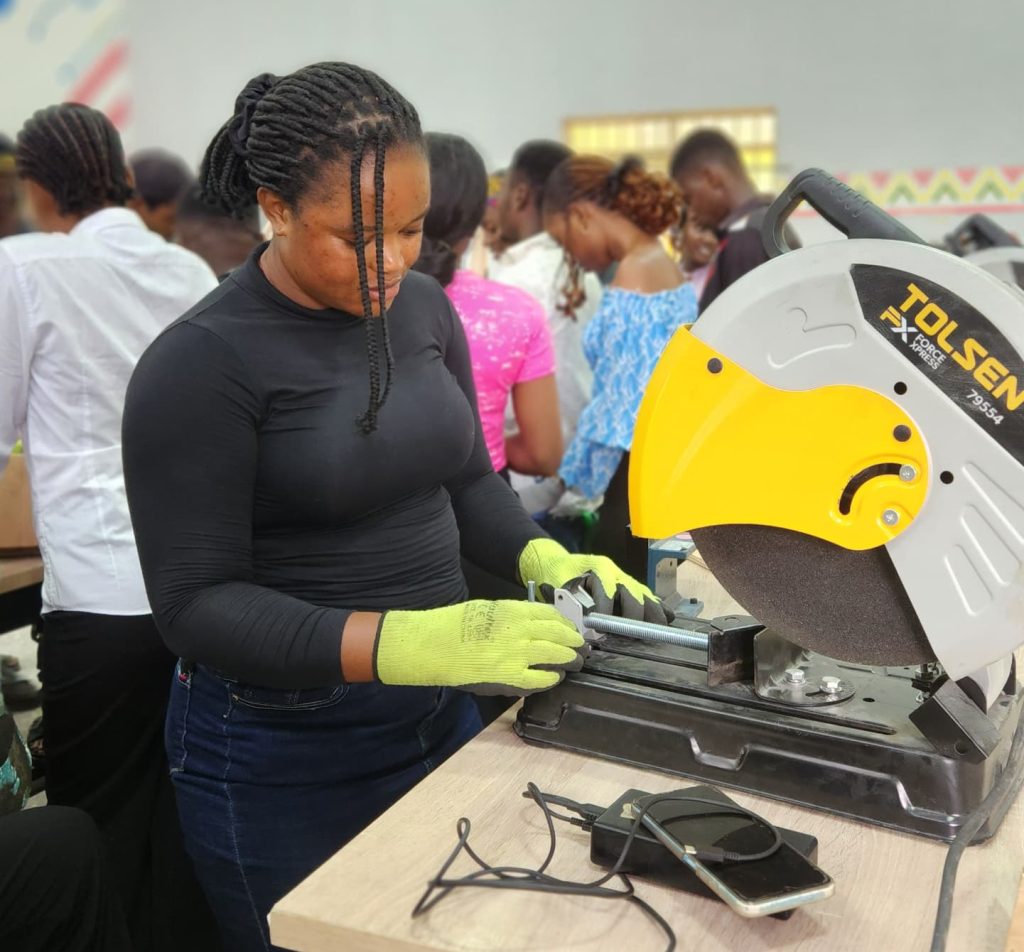
Delivery is by independent implementation partners, including QurateHQ, inside university innovation pods and working workshops. Real equipment, not pictures of it.
Every cohort carries workplace readiness alongside the trade, because a person who can weld and cannot invoice is still poor.
4. Stay Untill They Earn
Each learner is paired with a mentor before the course ends and followed at three, six and twelve months.
We record a wage job, a client, a sale, or nothing yet, and report it to whoever paid for the place.
Why the Foundation buys delivery instead of building it
A new organisation that builds its own training operation spends its first years on overhead: premises, machines, instructors, a curriculum, and the slow accumulation of a track record. The learners it was founded for wait through all of it.
Nigeria already holds the delivery capacity. Training organisations with completion records. University innovation pods equipped with machines that run for only part of the year. Technical colleges with instructors. Master craftsmen with more work than hands. What is missing is not the teaching. It is the money to put a poor young person in front of it, and someone accountable for what happens afterward.
So the Foundation stays small and buys delivery. Overheads fall, the first cohort starts in months rather than years, and a funder can inspect the track record of the organisation that will actually do the work.
Who does what
QurateHQ is not owned, controlled or operated by the Foundation, and other technical colleges, master craftsmen and employers may deliver other cohorts under the same terms.
Future Workforce Empowerment Foundation
Raises funds, selects beneficiaries, and pays for training. The nonprofit and public-facing body.
independent implementation partner
QurateHQ
A separate organisation with its own leadership, staff and clients, appointed under written agreement to deliver selected cohorts.
Where training happens
Part of the national UniPod rollout supported by UNDP. National infrastructure the Foundation pays for access to, not facilities we own or operate.
Manufacturing and the trades
Computer-aided design, 3D printing, fabrication, furniture assembly, light manufacturing, quality control.
Agriculture and food processing
Processing, storage, packaging, cold chain, farm records, route to market for a crop that currently rots.
Artificial intelligence
Support and service roles, data work, software, automation, and the judgement to use these tools responsibly.
Solar and green energy
Installation, battery assembly and maintenance, small system design, servicing contracts.
Resilience & Recovery
Construction trades, water and sanitation work, and enterprise skills for communities restarting after conflict or flood.
Mining and resource technology
Site safety, survey and mapping tools, mineral handling, the regulated end of an industry most young people meet informally.
Civic & Industrial Innovation
Construction trades, water and sanitation work, and enterprise skills for communities restarting after conflict or flood.
Workplace readiness
Written English for work, interviews, timekeeping, contracts, pricing your own labour. Taught alongside every other pathway, never instead of one.
All cohorts
The Foundation is new. Its delivery partner is not.
The Foundation has not yet run a cohort of its own. Under commission from the Abia State Government, QurateHQ’s ThriveAbia pilot produced the figures below. They belong to QurateHQ and to the state that commissioned the work, published here with the partner named
Three ventures from the pilot cohort are now in formation, and one platform, built by learners, is in use by the state.